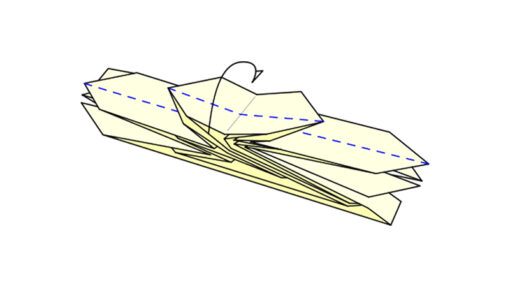
Pythagorean stretch

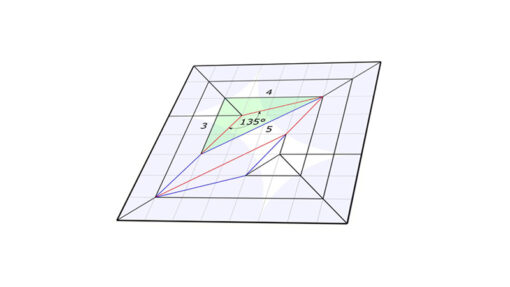
Post is a part of a larger series (Advanced concepts): Elias stretch Pythagorean stretch Pythagorean stretch - advance concept (no.1) Level shifters How to Collapse Box Pleated Crease Pattern? Pythagorean stretch Introduction Origami models based on a box pleating method are on average smaller compared to the similar models based on a circle packing method. In extreme cases,…

Continue Reading Pythagorean stretch
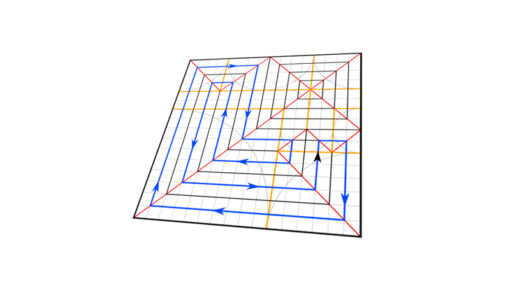
Axial creases

Post is a part of a larger series (Creases): Hinge crease Ridge crease Axial creases Axial crease is one of the three basic origami creases. By definition Axial creases are creases that run in the direction that is perpendicular to the polygon’s hinge creases. Simplest form of a axial creases In most basic form, meaning in the models…

Continue Reading Axial creases

Hinge crease

Post is a part of a larger series (Creases): Hinge crease Ridge crease Axial creases A hinge crease serves two purposes. By definition, a Hinge crease is a line that defines polygons by the mere fact it surrounds it. Also, a hinge crease is a line around which a flap can rotate. Hence the name. It looks similar…

Continue Reading Hinge crease

Can central flaps be free?

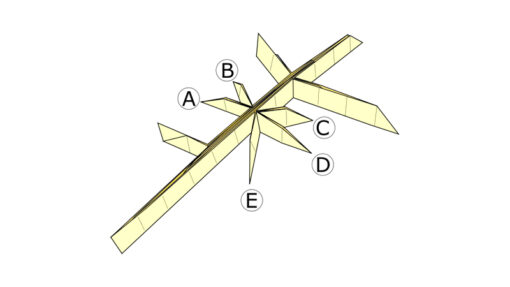
Post is a part of a larger series (Design process): Origami design process (introduction) Origami design process – Part 2 Origami and circles Relationships between basic elements of an origami model Maekawa-Justin and Kawasaki-Justin theorems How to hide an unused paper in your Origami model? Can central flaps be free? Why is central fold opening so popular? Crease…

Continue Reading Can central flaps be free?

Relationships between basic elements of an origami model

All basic elements of an origami model (flaps and rivers) must be in the same relationship, both on the stick figure and the crease pattern. Reason is quite simple. Both stick figure and crease pattern are a graphical representation of the same future model. Therefore, it is not possible for a crease pattern to show one thing and for a stick figure to show something else.

Continue Reading Relationships between basic elements of an origami model

Elias stretch

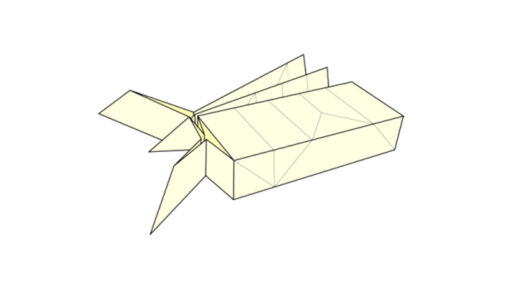
Elias stretch is an origami manoeuvre that is often used while collapsing origami models based on the Box pleating technique. It was named after Neal Elias, who popularized it in the 1970s. The technique is very simple and is used to assemble flaps (polygons) located on the paper edge. Basically, wherever you have a polygon that forms a flap and it is located on the paper edge, you can use Elias stretch manoeuvre to collapse that polygon.

Continue Reading Elias stretch